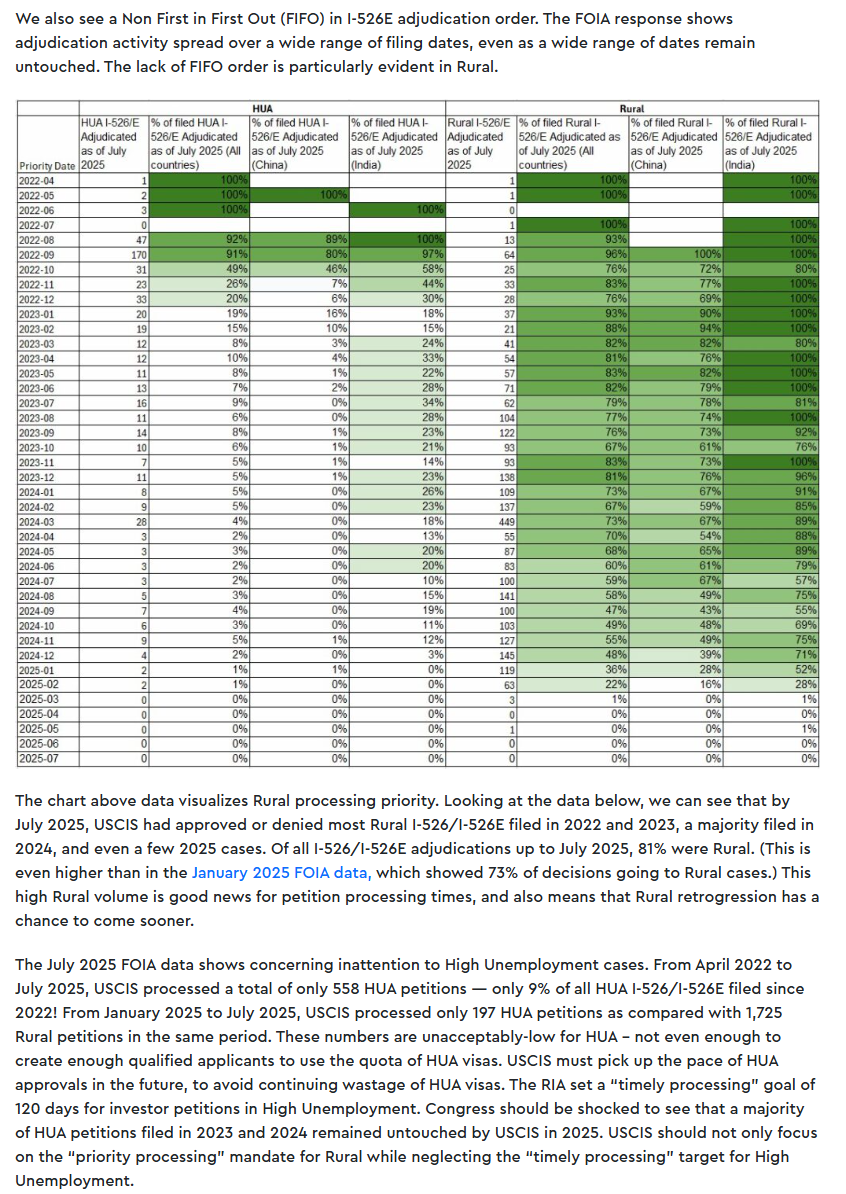
The data for the fourth quarter of Fiscal Year 2025 (July–September 2025) has finally settled. This report reveals a brutal yet clear reality: the EB-5 “bonus period” is shifting from a window where “anyone can make it” to one where “first come, first served, and selection is key.” If you are still viewing EB-5 through a lens from four years ago, you might miss this final opportunity to board the train.

Source: USCIS data on EB-5 immigrant investment filings and approvals for Q4 FY2025 (July to September 2025).
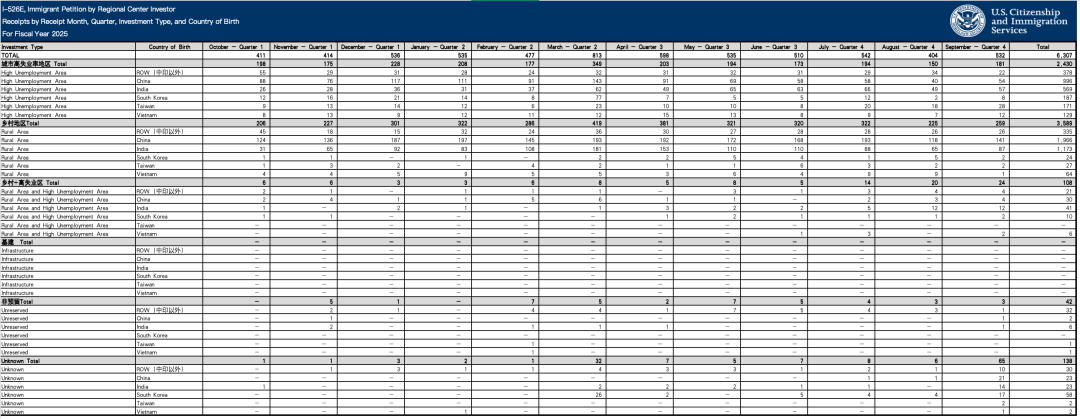
The data provides a detailed distribution of applications filed through Regional Centers for the entire 2025 fiscal year, categorized by visa set-aside types (Rural, Urban High Unemployment, etc.) and applicant nationality.
New Law Case Processing Data
A particularly striking feature of the data is the fundamental shift in the United States Citizenship and Immigration Services (USCIS) processing logic.
New Law I-526E: In Q4 FY2025, the number of filings under the new law (the EB-5 Reform and Integrity Act of 2022) decreased slightly compared to the previous quarter but remained at historic highs. New law approvals officially surpassed 1,300 this quarter. This indicates that USCIS has redeployed the vast majority of its personnel to the “New Law” track.
The “Dimensional Strike” of Rural Projects: According to the latest FOIA data from July, while rural filings account for 47% of the total new law volume, they contributed over 80% of the approval results. The conversion rate for rural projects is significantly higher than other categories. Due to the “priority processing” mechanism, some cases have been approved in approximately 10 months. In contrast, while processing for High Unemployment Areas (HUA) has picked up, it still lags behind Rural projects.
This shift in processing rhythm is backed by USCIS resource allocation and the new processing regulations set to take effect on March 30, 2026. These regulations clarify the principles of priority processing for rural projects and “first-in, first-out” for all categories, making the adjudication cycle more predictable. Currently, the average processing time for I-526E under the new law has stabilized at 10–14 months, making it one of the most efficient options in the employment-based immigration category.
“Water Temperature” Report: The Three Reserved Channels
The “Visa Set-asides” established by the new law offer a rare path for investors in the U.S. to obtain Green Cards quickly. However, the three channels now show very different levels of “heat”:
Urban TEA Projects (10% Quota) – A Crowded “Red Ocean” This is the category with the highest number of projects on the market. The “invisible retrogression” (the number of filed but unapproved cases) has already far exceeded the annual quota. For new entrants, this is no longer a “no-wait” project, but a “waiting-in-line” project.
Rural Projects (20% Quota) – The Undisputed Fast Track Fast approval, high success rate, and a genuine priority processing category. Although a surge in 2025 filings may lead to retrogression pressure by late 2026, the large quota share ensures it remains the premier fast track for now.
Infrastructure Projects (2% Quota) – A Rare Luxury Projects in this category are few and far between, with minimal processing data available. For investors with specific needs, this remains a “Blue Ocean.” While choices are limited (only 6–7 approved infrastructure projects currently exist with roughly 300 I-526E filings), the “water level” remains low compared to the nearly 10,000 filings each for Urban and Rural categories.
Three “Danger Signals” for Fiscal Year 2026
How long will “No Retrogression” last? While the Visa Bulletin currently shows “Current,” the application pool is expanding rapidly. In the Urban TEA category, the actual wait time for those filing now could potentially reach 10 years.
Concurrent Filing Window: H-1B or F-1 students currently in the U.S. must utilize the “Concurrent Filing” policy. This allows one to obtain a Work Permit (EAD) and Travel Document (AP) while waiting. This benefit relies entirely on a “Current” status; once retrogression hits, this window closes.
Impending Price Adjustments: Under RIA terms, investment amounts are adjusted every five years. The market is already reflecting anticipation of a 2027 price hike, which will further drive demand to “get in early” during 2026.
Conclusion: How Should You Decide?
If you seek speed: Lock in a Rural or Infrastructure project. Rural projects are protected by law for priority processing and have the largest quota. Infrastructure projects, while having a smaller quota, have significantly fewer applicants, meaning faster movement through the line.
If you are in the U.S.: Seize the Concurrent Filing opportunity. During the “No Retrogression” period of 2026, file immediately. Getting your EAD and AP is often more critical for solving immediate career anxiety than the Green Card itself.
If you are still observing: Remember, EB-5 quotas are allocated by filing date. In a pool with a fixed number of spots, every day of hesitation adds years to your future wait.
Would you like me to create a summary table comparing the specific pros and cons of Rural vs. Urban TEA projects based on this data?